Agent Shift Mac OS
Agent Shift Mac Os 11
For some time now I am running into situations were the McAfee Agent installed on Apple systems is not responding to the 'run client task now' command (failed) or 'wake up' ePO function. This is happening with different Agent and os versions, quite recently with Agent 5.5.1.374 and OS 10.14.3. Any solutions or troubleshooting steps that come to. Note: To see a complete list of keyboard shortcuts, open Google Slides and press Ctrl + / (Windows, Chrome OS) or ⌘ + / (Mac). Use ⌘ for Mac or Ctrl f or Windows, Chrome OS. So use without switch “-f” for normal Installation and vice versa.Normal Install / upgrade- $ sudo sh install.sh -i -For force re-install- $ sudo sh install.sh -i -f. In conclusion, by doing simple tweak we did force re-install same version of McAfee agent on Mac OS. Hope this does helps you.
Install the appropriate version of the VCM Agent on each of your licensed target machines to enable communication between the Collector and the managed
Installing the Agent on
Prerequisites
- Verify that the machine on which you intend to install the Agent has enough free disk space. Formore information, see the VCM Installation Guide.
- If you are installing the Agent on Red Hat Enterprise Linux (RHEL) 7, Oracle Enterprise Linux (OEL) 7, or CentOS 7, verify that the
net-toolsandredhat-lsb-corepackages are installed on the target machine. - Identify the Agent binary installation package that you will copy from the Collector to the managed machine. See the VCM Installation Guide.
- If you run an installation in silent mode, modify the appropriate csi.config file variable options. See Installation Options for Max OS X csi.config .
- If you select (x)inetd/launchd for CSI_AGENT_RUN_OPTION, verify that (x)inetd/launchd is running on the target machines. On some versions, when (x)inetd/launchd services are not configured, (x)inetd/launchd will not stay running. To ensure the Agent installation completes successfully, pass a - stayalive option to (x)inetd/launchd. See Installation Options for Max OS X csi.config .
- Log in to the target
- Select the method that you want to use to copy files to the target machines. You can use ftp, sftp, or cp using an NFS share. If you use ftp to copy the package to your machine, you must use binary mode.
- If you are collecting non-ASCII information from the target machines, install a UTF-8 locale. To determine the locales installed on your operating system, use the locale -a command.
Procedure
Copy the appropriate Agent binary installation package from the Collector to the machine on which you will install the Agent.
The Agent packagesare located on the Collector in Program Files (x86)VMwareVCMInstallerPackages.
- On the target machine, run chmod u+x <filename> to set the execute permission for the file owner on the Agent binary file.
In the directory to which you copied the file, run ./CMAgent.<version>.<Agent binary name> to create the necessary directory structure and extract the files.
To force an overwrite of any existing files, include the -o option.For example: /CMAgent.<version>.
The command and output is similar to the following example, but with different file names depending on the operating system.
# ./CMAgent.<version>.Darwin
UnZipSFX 5.51 of 22 May 2004, by Info-ZIP (http://www.info-zip.org).
creating: CSIInstall/
inflating: CSIInstall/CMAgent.5.1.0.Darwin.ppc
inflating: CSIInstall/csi.config
inflating: CSIInstall/InstallCMAgent- Run cd <extractedpath>/CSIInstall to change the directory to the location where the InstallCMAgent executable file was extracted.
Run ls -la to validate that the correct files are in the <extractedpath>/CSIInstall directory.
File Description InstallCMAgent Installation script. csi.config Configuration file for the installation. This is the file you can modify to include installation options for silent rather than interactive installation processes. packages Installation packages. scripts Scripts required for the installation. (Optional) Edit the csi.config file to customize the installation variables and save your changes.
- Run the chmod u+x csi.config command to add write file permissions if the file has only read permissions set.
- Modify the csi.config file options based on your local requirements and save the file.
Copy the modified and saved csi.config file to the extracted location.
For example, # cp /<safelocation>/csi.config /<extractedlocation>/CSIInstall/csi.config.
Run InstallCMAgent in either silent mode or interactive mode.
Option Action Silent mode
Run the # ./CSIInstall/InstallCMAgent -s command.
Install the Agent using the silent mode if you manually edited the csi.config file, if you modifiedthe csi.config file using the interactive method, or if you are using a custom configuration file thatyou saved from a previous Agent installation. This mode uses the valuesspecified in csi.config without prompting for input.
When the silent installation finishes, a summary of the installation process and status appears.Verify that the installation finished without errors.
Interactive mode
Run the # ./CSIInstall/InstallCMAgent command.
Install the Agent using the interactive mode if you did not modify the csi.config and to respond to each prompt toaccept or change each parameter in the csi.config file as it runs. As a result of your responses, the csi.config is modified.
The preinstallation stage of interactive mode checks for a valid user, CSI_USER. If the user exists, you are not prompted for these configuration values.
- CSI_USER_NO_LOGIN_SHELL
- CSI_USER_PRIMARY_GROUP
- CSI_USER_PRIMARY_GID
- CSI_USER_USE_NEXT_AVAILABLE_LOCAL_GID
You are prompted for these values only when the CSI_USER user account is not found.
The User and the Group are created in the local directory service storage.
You can check the installation status in the installation log file. The file is located in <CSI_PARENT_DIRECTORY>/log/install.log.
Run ls –la /CSI_PARENT_DIRECTORY/CMAgent to verify that all the required files and directories were installed.
/CSI_PARENT_DIRECTORY/CMAgent is the default directory. If you changed the directory name during installation, modify the ls -la command to display the custom directory name.
drwxr-x--- 3 root cfgsoft 4096 Jul 2 17:34 Agent
drwxr-x--- 3 root cfgsoft 4096 Jul 2 17:34 CFC
-rw-rw---- 1 root cfgsoft 49993 Jul 2 17:34 CSIRegistry
-rw-rw---- 1 root cfgsoft 0 Jul 2 17:34 .CSIRegistry.lck
drwxrwx--- 3 csi_acct cfgsoft 4096 Jul 2 17:34 data
drwxrwx--- 3 root cfgsoft 4096 Jul 2 17:34 ECMu
drwxr-x--- 6 root cfgsoft 4096 Jul 2 17:34 install
lrwxrwxrwx 1 root root 20 Jul 2 17:34 log -> /var/log/CMAgent/log
dr-xr-x--x 3 root cfgsoft 4096 Jul 2 17:34 ThirdParty
drwxr-xr-x 2 root root 4096 Jul 2 17:34 uninstallRun # netstat -na grep <port_number> to verify that the Agent is installed correctly, listening on the assigned port, and ready to collect data.
The default <port_number> is 26542 for VCM installations.
What to do next
Run a collection for Mac OS X data. See Collect Mac OS X Data.
See Also |
|---|
| Manually Uninstalling the Mac OS X Agent |
Help us improve this topic. Send feedback to . Technical Support © 2006–2015 VMware, Inc. All rights reserved. This product is protected by U.S. and international copyright and intellectual property laws. VMware products are covered by one or more patents listed at http://www.vmware.com/go/patents. VMware is a registered trademark or trademark of VMware, Inc. in the United States and/or other jurisdictions. All other marks and names mentioned herein may be trademarks of their respective companies.
Organizations today increasingly deploy Mac devices. Due to this overall influx, the amount of Active Directory (AD) password reset requests for Mac devices has grown exponentially, as well. Thus, the IT teams of these organizations are forced to spend a lot of time handling repetitive tickets. To solve this issue, organizations can now adopt a self-service password management solution, such as ADSelfService Plus. This tool solution provides Mac users a self-service web portal manage their own passwords and accounts, without depending on the IT team, reducing administrative time spent on repetitive requests.
Streamlining the Solution
In the past, the web portal from ADSelfService Plus had to be accessed from a dedicated, secure system. This is no longer the case; ADSelfService Plus has introduced the Mac login agent for password resets. The login agent is an extension of the web client, which allows Mac users to reset their Active Directory passwords right from their login screen. The login agent is not a complete substitute the web portal, but allows users to reset passwords from the comfort of their own systems.
What Can the Login Agent Do?
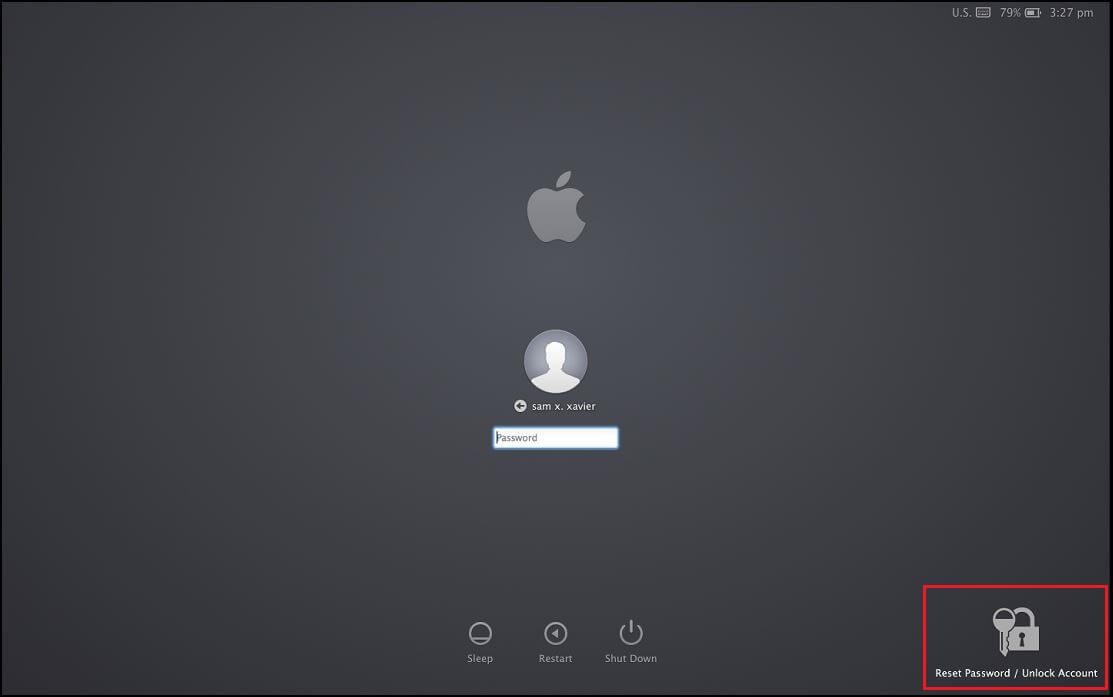
The login agent is run by the Mac OS as a part of the lock screen.Clicking the “Reset Password/Unlock Account” button opens a secure browser, from which AD users can authenticate themselves, and reset their forgotten passwords.
Easily access the login agent from the desktop by keying in the keyboard shortcuts “CONTROL+SHIFT+EJECT” or “CONTROL+SHIFT+POWER”, depending on the Mac version.
How Do I Enable the Login Agent?
Installing the Mac login agent is simple and quick. You can bulk install client software to the users' machines from a centralized ADSelfService Plus console, through domain or OU-based filters, or a CSV file with the necessary details of the Mac devices. ADSelfService Plus also allows administrators to customize the icon and text associated with the login agent. For more customization details, click here.
The ADSelfService Plus Mac Login Agent Advantage
The login agent for Mac users, from ADSelfService Plus, is advantageous to both users and administrators alike.
- Allows Mac users to reset their password and unlock their account directly from their device, without having to search for a secure terminal to access the ADSelfService Plus portal.
- Reduces the workload of administrators and help desk personnel.
- Decreases turnaround time, to increase user productivity.
- Minimizes cost incurred on Active Directory password reset requests.
Enable macOS users to reset AD passwords from their login screen.
Thanks!
Your download is in progress and it will be completed in just a few seconds!
If you face any issues, download manually here
Password self-service
Free Active Directory users from attending lengthy help desk calls by allowing them to self-service their password resets/ account unlock tasks. Hassle-free password change for Active Directory users with ADSelfService Plus ‘Change Password’ console.
One identity with Single sign-on
Get seamless one-click access to 100+ cloud applications. With enterprise single sign-on, users can access all their cloud applications with their Active Directory credentials. Thanks to ADSelfService Plus!
Password/Account Expiry Notification
Intimate Active Directory users of their impending password/account expiry by mailing them these password/account expiry notifications.
Password Synchronizer
Synchronize Windows Active Directory user password/account changes across multiple systems, automatically, including Office 365, G Suite, IBM iSeries and more.
Password Policy Enforcer
Ensure strong user passwords that resist various hacking threats with ADSelfService Plus by enforcing Active Directory users to adhere to compliant passwords via displaying password complexity requirements.
Directory Self-Update & Corporate Search
Agent Shift Mac Os X
Portal that lets Active Directory users update their latest information and a quick search facility to scout for information about peers by using search keys, like contact number, of the personality being searched.